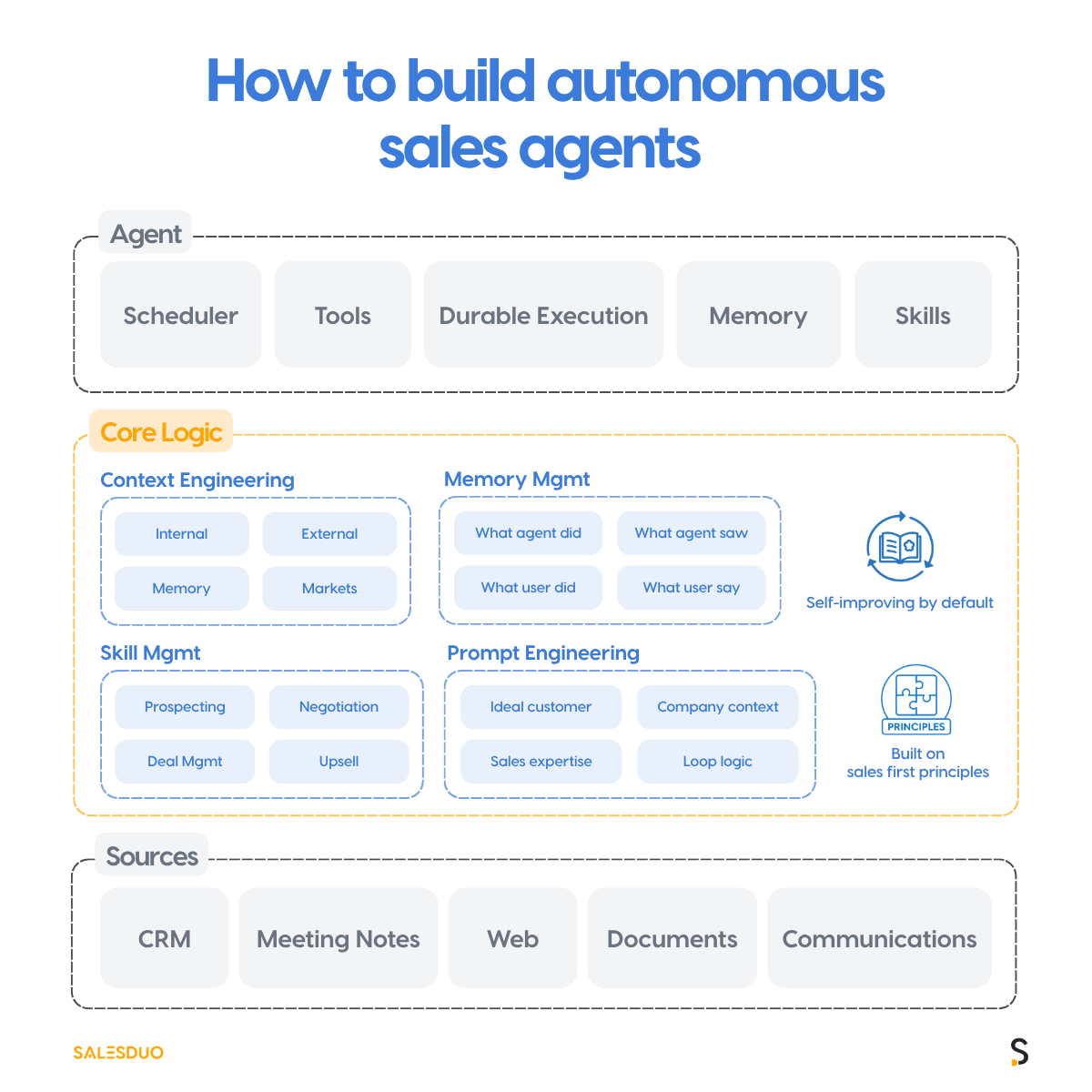

After iterating 50+ versions of different sales agentic infrastructure, this is my verdict on how to build: the autonomous sales agents of the future I spent the past two months running evals (evaluation tests) to figure how to build sales agent that: - fully autonomous - works 24/7 - zero HITL (human-in-the-loop) - self-improving - scalable impact Background: I am building for APAC where you have 36 different countries and market context. Relationship-driven. Trust first. Users want done-for-you. Here are the premises of my argument: [1] Fully autonomous To achieve fully autonomous, it means you had to ensure that the tasks that agents did must not involve HITL. Humans stay as the primary communicators. Agents perform everything before and after communication. This means direct interaction (email, call, chat) must be the human's job. Agent prepare everything before and after these interactions. Drafts do not require HITL Enrichment do not require HITL Research do not require HITL Proposal do not require HITL Notification do not require HITL [2] Scalable & self-improving We treat agents as a scalable sales team asset, rather than a step in a workflow. Every target account in CRM is assigned with its own account agent (1:1). Every agent builds its context and memory around its assigned target account. Instead of building workflow agents: - prospecting agent - competitor analysis agent - deal agent We treat prospecting, deal management, negotiation and etc. (sales knowledge) as agent skills. Instead of treating company playbook and ICP as context, We treat it as always-on information in the agents' system prompt to build its default sales lens. In every account agent context, we built them on 4 core dimensions: <Internal> Past/current conversations, meeting notes, emails, etc Past/current deals, agreements, quotations Internal communication discussions Product usage Marketing analytics ...anything only known in your internal systems. </internal> <External> Social signals Company news Job posting signals Annual reports/SEC Funding signals ...anything researchable from the world wide web </external> <Memory> What agent has done in every run to reduce repetitive slop What agent has learnt from previous runs to improve proactively What user has done, whether they completed the suggested actions (and learn from the user best practices) What user has feedback to the agent </memory> <Markets> ...dynamically loaded based on the target HQ Culture Business practice Regulatory & Compliance Holidays Trends ...anything that influence markets on a country/region/global scale </markets> The 4 core pillars of context: internal, external, memory, markets To close the loop of agents' knowledge, every action, update, CRUD taken by the agent updates natively in the CRM, back into the system of records. Our belief is to treat agents as account agents, not workflow agents. Why?
Account agents self-learns and self-improves throughout the sales lifecycle from: non-customer (cold) > prospecting > deal management > negotiation > customer management > upsell > repeat
The crux is without the need for the sales team OR a rev ops team to manually edit skills, documents, workflows.
The more intelligent the model gets, the better your account agents are going to be able to think and adapt like a human seller.
On the flip side, designing workflow agents like prospecting agent, negotiation agent, deal analysis agent, product analysis agent, etc.. means someone on your team needs to own the workflow.
Someone will need to refine the workflow to make it more advanced as you expand. Someone will need to update the logic manually based on patterns they identified. Someone will need to create new workflows along every step of the sales lifecycle. Someone will need to re-write the entire playbook for every new market.
Account agents are not all that perfect too. 10,000 target accounts means you need to manage 10,000 account agents reliably. Tweaking a singular account agent requires proper scalable infrastructure to store thousands of custom memory + skills.
As opposed to workflow agents, they are typically clear workflows with agents, that might be easier to debug errors and faster to set up.
The reason why I think account agents are the future is because of the market I’m uniquely positioned in:
APAC
GTM (Go-To-Market) is almost unknown or a very foreign term to most leaders here. Companies here want “do-for-you” experiences. Adoption rate of new technology here is dramatically slower than in Western countries.
Not only that, sales in APAC is very relationship-first.
Going out to meet customers face-to-face is way more important to sales people than updating CRM or creating an automated workflow.
For APAC sellers, the experience of AI tools must not only alleviate manual work, it must remove the need of it completely.
Agents must be proactive + autonomous in enriching crucial data fields, finding relevant stakeholders, researching for company signals, and more → Users must not need to manually prompt or chat with the agent to take action.
Agent must be self-learning and self-improving in learning from its own mistakes, what it has tried, what the user has done and what the user has feedback. → Users must not need to manually update agent skills, tools, prompt constantly to make it better.
In conclusion, the future of AI agents is not second generation workflows. It is a world where humans and agents work seamlessly together to a joint outcome. In sales, account agent is the future, where a sales account executive and an account agent work hand-in-hand to close one account deal at a time.
The future is just getting started and we are leading it in APAC at SalesDuo.