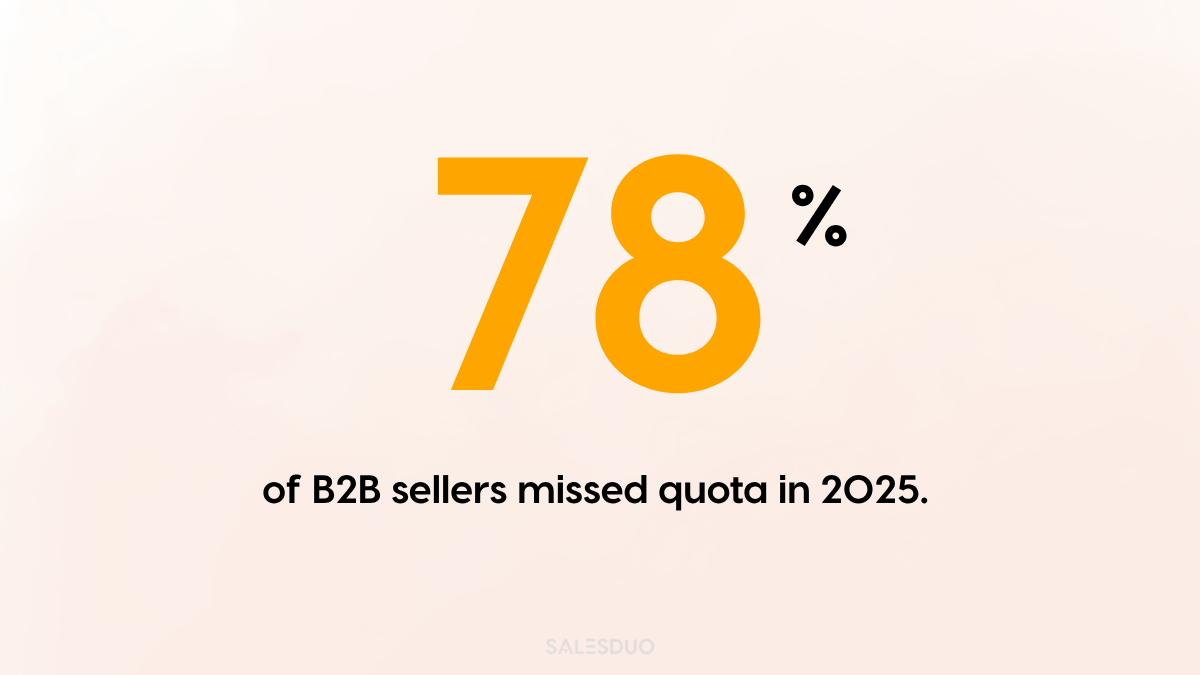

78% of B2B sellers missed quota in 2025. Reply rates have fallen 70%+ in three years.
Buyers finish two-thirds of their journey before they talk to you. This isn’t a macro slump.
It’s a structural collapse, and the AI era is accelerating it, not fixing it.
In 2025, 78% of B2B sellers missed quota. Up from 69% in 2024. That is not a typo and it is not a rounding error. It is a profession failing to clear the bar at historic rates, two years running, per Ebsta’s 2025 GTM Benchmarks across 440,000+ opportunities worth $43B.
The industry’s response has been a collective shrug. “Macro headwinds.” “Longer sales cycles.” “Buyers are cautious.” All true. All insufficient.
When the overwhelming majority of a profession fails to hit the bar for two consecutive years, the bar is not the problem. The operating model is.
That is the claim this letter is built on. And in the AI era, the collapse is accelerating, not reversing.
The numbers, stacked
Forrester surveyed 3,031 global sellers and found the average B2B rep spends 23% of the work week actually selling, i.e. talking to prospects and customers. On a 50.8-hour week that is about 11.7 hours of real selling. The rest is admin, internal meetings, research, and reporting.
Gartner ran the same question from the other side. Its 2023 survey of 501 sellers found 77% struggle to complete their assigned tasks efficiently, despite record investment in tech, training, and enablement.
Salesforce’s 2025 State of Sales adds the complexity tax: reps use 8 tools on average to close a deal, 42% feel overwhelmed by the stack, and overwhelmed sellers are 45% less likely to attain quota. Separately, 27% of reps fail to log essential interactions at all.
Ebsta’s performance-tier data shows the gap widening. The velocity delta between top and bottom sellers went from 7x in 2023 to 9x in 2024 to 11x in H1 2025. Top teams are not just winning more. They are winning faster, with fewer deals, against reps who look identically equipped on paper.
Your reps are selling for less than a quarter of the week. The rest is a kind of professional cosplay: updating records nobody reads, drafting emails nobody answers, sitting in forecast calls that do not change the forecast.
Then the industry looks at 78% missed quota and blames the buyer.
The AI-era headwinds nobody priced in
Here is what makes 2025 different from 2022. The macro narrative conveniently ignores it.
Buyers finished the journey before you got the meeting. 6sense’s 2025 Buyer Experience Report shows B2B buyers now delay seller contact until two-thirds of the way through their journey, shortlist ~4 of 5 vendors on day one, and ultimately buy from that shortlist 85% to 95% of the time. Most “discovery calls” are actually confirmation calls. The deal was decided before your rep’s calendar invite was accepted.
Buying committees ballooned. Buying groups now average 10+ stakeholders, with complex deals hitting 11–13. Every extra stakeholder adds consensus cost. Every consensus cost pushes the close date right.
Cold email broke, then broke again. B2B cold email reply rates collapsed from a median of 3.5–4% in early 2023 to roughly 1–1.5% by early 2026, a 70%+ drop in under three years. Gmail and Yahoo enforced new sender requirements in February 2024 (SPF, DKIM, DMARC, 0.3% spam threshold, one-click unsubscribe), and 1 in 6 marketing emails failed to reach the inbox in 2024. The channel that funded a decade of B2B pipeline now fights the inbox providers for delivery.
Buyers distrust AI-generated content. 96% of B2B marketers use AI in their role, but only 4% of B2B buyers trust what AI says about a vendor, and over half say they are less likely to engage with content they suspect is AI-generated. The tools bought to scale outreach are actively suppressing the outreach they produce.
The AI SDR category is collapsing in public. 11x raised $76M on a “replace your SDRs” thesis; the founder has since publicly conceded AI SDRs “don’t work,” and TechCrunch reported the company was listing customers it did not have. Artisan’s “Stop Hiring Humans” billboard campaign has quietly pivoted to “augment your team,” and the company is now hiring humans. 70% of AI SDR users churn within three months, AI SDR tools churn at 50–70% annually, and industry-wide only 19% of reps actually use the AI features built into their sales stack.
This is the actual macro environment. Not “buyers are cautious.” Structural collapse of the channels, messages, and tactics B2B sales was built on, all at once, in 24 months.
The seven thieves still inside every calendar
Underneath all of this, the day-to-day shape of the seller’s week has not changed. Time-box one rep for one week and you will find the same seven thieves, regardless of tools, tenure, or geography:
- CRM hygiene. Updating stage, amount, close date, next steps. Mostly retroactive. Mostly for someone else’s dashboard.
- Pre-call research. 15 to 45 minutes of Googling and LinkedIn stalking for a 30-minute call. Half of it forgotten by the time they join the Zoom.
- Post-call admin. Notes typed from memory. Tasks created by hand. Follow-ups drafted slowly, a day late.
- Internal reporting. Pipeline reviews, deal desks, slide updates, forecast pre-reads. Hours per week producing artefacts that do not change an outcome.
- Tool switching. Living across HubSpot, LinkedIn, WhatsApp, Slack, Notion, Gong, Apollo, and email. 8 tools per rep. 42% overwhelmed. 45% less likely to hit quota.
- Follow-up drafting. Bespoke and slow, or templated and ignored. Both are bad.
- Forecast theatre. Saying “commit” or “best case” with conviction nobody actually has, because looking unprepared is worse than being wrong.
Every rep has this list. Every rep knows it. Very few leaders write it down.
Why leaders will not name it
Every Head of Sales I speak with knows all of this privately. None of them say it publicly. Naming it has costs.
Naming it means:
- The org chart is wrong. You do not need a 6th rep. You need your existing 5 to operate at 1.3x.
- The stack is bloated. Some of the tools you bought to fix this are, quietly, part of the problem.
- The next hire will not save you. They will inherit the same broken day by week two.
Those are uncomfortable conclusions. So instead the industry blames the macro, rewrites the comp plan, buys another AI tool, and pretends.
I understand the incentive. It is not working.
The false fix
The default playbook when quota slips: hire.
In Singapore, a loaded 6th AE costs roughly $60,000 a year. Six to nine months to ramp. At the end of that ramp, they inherit the same 23% selling-time ceiling as everyone else on the team.
You did not solve the productivity problem. You paid $60K to replicate it.
Now scale that logic. The 7th rep. The 8th. Every new seat is another human tax-payer to the same broken operating model, not a multiplier on top of it.
This is why Salesforce’s 2026 sales trend research identified “increasing the productivity of existing teams” as the #1 CRO growth priority, jumping from #4 the previous year. Leaders have stopped pretending the next hire fixes this. They are just not sure what does.
The real fix, and why AI changes the math
There is a better bet. Take the reps you already have and change the shape of their day.
The operating model SalesDuo is built on:
- Pre (AI). Research, briefings, warm paths, signal detection. Everything that happens before the human shows up.
- During (Human). The conversation itself. Judgment, empathy, the whisper-note that saves the $80K deal.
- Post (AI). Drafts, CRM updates, tasks, next-touch, the expansion trigger three months later.
AI is better than humans at Pre and Post. Humans are better than AI at During. Organise around that truth and the math inverts.
The evidence is already in. Gong analyzed 7.1M opportunities and found sellers who frequently use AI generate 77% more revenue per rep than those who do not, roughly a six-figure delta per seller per year.
McKinsey estimates gen AI will unlock $0.8 to $1.2 trillion in incremental productivity across sales and marketing. HubSpot’s 2025 State of Sales found 84% of reps say AI saves time, 83% say it personalizes interactions, and AI was rated the highest-ROI tool category at 31%.
The catch: McKinsey also found only 19% of B2B companies have implemented gen AI in selling, another 23% are in progress, and industry-wide only 19% of reps actually use the AI features built into their sales tools.Most “AI adoption” is reps copy-pasting into ChatGPT off to the side. The gap between what companies buy and what reps use is the hidden reason AI has not moved the headline quota number yet.
The teams that close that gap win the next three years. The ones that do not become case studies.
The test
Here is what I would do tomorrow if I ran a sales team.
Pick one rep. Pick one day. Log every 5-minute block. Categorise each block against the seven thieves above. Show the team the result.
Not to shame anyone. To make visible what everyone already feels.
Until you see the shape of the day, you cannot change it.
I built a free template for this exact exercise. It calculates selling-time percentage automatically and maps every block to one of the seven thieves. Take it and run the experiment.
👉 Download: The Rep Time Audit Template
Run it for one week on one rep. Send me what you find. I will anonymise and publish the aggregate in a future issue.
The question that actually matters
The question Heads of Sales keep asking is who else should I hire?
The question that actually matters is what is my team doing for 8 hours a day, how much of it is selling, and what in the AI era just made that harder?
Ask the second question honestly and the answer rearranges everything: your stack, your org chart, your outbound channel mix, your next quarter’s plan.
78% missed quota isn’t a slump. It’s a signal.
The job has changed. The channels have broken. The buyer has moved. Most teams haven’t.
If this was useful, forward it to one Head of Sales/Revenue you respect. That is how The AI-Native Seller grows.
I’m Justin, founder of SalesDuo. Your reps are selling 23% of the week. The other 77% is research, CRM updates, follow-up drafts, and admin nobody signed up for. SalesDuo is the revenue agent that does the pre and post-call work for them, with full context on every account. Growing teams use us to hit 2x output without hiring 2x reps. If that’s your problem, book 20 minutes.
Footnotes
- 78% missed quota in 2025, up from 69% in 2024; 11x velocity gap. Ebsta 2025 GTM Benchmarks Report (440,000+ opportunities / $43B analyzed). https://benchmarks.ebsta.com/2025-gtm-benchmarks
- 23% selling time; 50.8-hour work week; 3,031-seller activity study. Forrester, Use Science to Improve Sales Team Productivity. https://www.forrester.com/blogs/use-science-to-improve-sales-productivity/
- 77% of sellers struggle to complete assigned tasks efficiently. Gartner press release, Nov 2 2023, based on survey of 501 sellers. https://www.gartner.com/en/newsroom/press-releases/2023-11-02-gartner-survey-finds-77-percent-of-sellers-struggle-to-complete-their-assigned-tasks-efficiently
- 8 tools per rep; 42% overwhelmed; overwhelmed sellers 45% less likely to attain quota; 27% don’t log interactions. Salesforce, 40 Sales Statistics to Watch for in 2026. https://www.salesforce.com/sales/state-of-sales/sales-statistics/
- Buyers delay seller contact until ~two-thirds of journey; 10+ stakeholders; buy from day-one shortlist 85–95% of the time. 6sense 2025 B2B Buyer Experience Report. https://6sense.com/science-of-b2b/buyer-experience-report-2025/
- B2B cold email reply rates 3.5–4% (early 2023) → 1–1.5% (early 2026). SDR-leader aggregation, SmartReach industry data, Feb 2026. https://www.linkedin.com/pulse/why-reply-rates-collapsing-what-top-1-sdr-teams-refuse-ignore-77cdc
- Gmail / Yahoo Feb 2024 sender requirements (SPF, DKIM, DMARC, 0.3% spam threshold, one-click unsubscribe); 1 in 6 marketing emails failed to reach the inbox in 2024. Google Workspace Email Sender Guidelines (https://support.google.com/a/answer/81126); Stripo 2024 deliverability stats via Martal Group (https://martal.ca/email-deliverability-lb/).
- 96% of B2B marketers use AI; only 4% of buyers trust AI outputs about a vendor; >50% of buyers less likely to engage with suspected AI content. Demand Gen Report, March 2026, via Koka Sexton. https://www.linkedin.com/pulse/trust-collapse-94-b2b-buyers-use-ai-research-you-only-koka-sexton-jzmdf
- 11x raised $76M on AI-SDR thesis; founder acknowledged AI SDRs “don’t work”; TechCrunch reported 11x listing customers it did not have. TechCrunch, Mar 24 2025. https://techcrunch.com/2025/03/24/a16z-and-benchmark-backed-11x-has-been-claiming-customers-it-doesnt-have/
- Artisan “Stop Hiring Humans” pivot to augmentation; company now hiring humans. Industry reporting (Christian Kletzl, UserGems, Nov 2025; Amos Bar-Joseph). https://www.linkedin.com/posts/christiankletzl_11x-raised-76m-on-a-claim-ai-sdrs-will-activity-7435744422866255872-ENQM
- AI SDR user churn ~70% within 3 months; tool churn 50–70%/year; only 19% of reps use built-in AI features. Prospeo, Will SDRs Be Replaced by AI? What the Data Says (2026). https://prospeo.io/s/will-sdrs-be-replaced-by-ai
- “Productivity of existing teams” now #1 CRO growth priority, up from #4. Gong State of Revenue Growth, via VentureBeat Dec 2025. https://venturebeat.com/ai/gong-study-sales-teams-using-ai-generate-77-more-revenue-per-rep
- Sellers who frequently use AI generate 77% more revenue per rep (Gong Labs analysis of 7.1M opportunities). Gong, The Best Sales Insights of 2025. https://www.gong.io/blog/the-best-sales-insights-of-2025
- $0.8T–$1.2T incremental productivity opportunity from gen AI across sales & marketing; 19% of B2B decision-makers implementing gen AI in selling, 23% in progress. McKinsey, Unlocking Profitable B2B Growth Through Gen AI, Mar 27 2025. https://www.mckinsey.com/capabilities/growth-marketing-and-sales/our-insights/unlocking-profitable-b2b-growth-through-gen-ai
- 84% of reps say AI saves time; 83% say AI personalizes interactions; AI rated highest-ROI tool (31%); 37% of reps use AI tools. HubSpot 2025 State of Sales Report. https://blog.hubspot.com/sales/hubspot-sales-strategy-report