
Every sales leader in Southeast Asia knows this moment.
You just hired your third rep in six months. Pipeline is growing. You are using one of fifteen hyped new AI sales tools that raised money last year.
Then the rep leaves.
And you realise the tool knows nothing.
Not why the deal went quiet. Not that your champion changed companies. Not that one CFO in Jakarta replies in twenty minutes, the one in Bangkok replies in twenty days, and the one in Manila needs a WhatsApp voice note before any email lands.
The tool remembers fields. It does not remember context.
That is the gap destroying sales teams in APAC. And no sales AI built for Western markets has seriously tried to close it.
Western AI was not built for this
Most sales intelligence platforms were architected around a specific mental model.
One language. One timezone. One dominant channel (email). Predictable firmographic signals. A CRM culture where sellers actually log their notes.
None of that holds in APAC.
A single enterprise deal in Southeast Asia spans six countries, four languages, three relationship layers (who you know, who they know, who introduced you), and five communication channels. Email. WhatsApp. WeChat. LINE. In-person meetings that never make it into any system.
The buying committee in Singapore defers to regional HQ in Australia. Which defers to a parent company in Japan. The champion you built for eight months just moved to a competitor.
Western sales AI processes these as edge cases.
In APAC, they are the default.
Signal intelligence is even worse. Platforms built for North America ingest press releases, SEC filings, G2 reviews, LinkedIn job postings. In APAC, buying intent surfaces in local language news, government procurement databases, trade association announcements, and the social content of executives on platforms no Western signal provider tracks.
Your AI outbound tool has a blind spot the size of half the world’s GDP.
A CRM is not a memory system
The standard vendor response is: “just keep your CRM clean.”
That is not an answer. That is a polite way of saying: “let your rep be the context layer.”
A CRM is a filing cabinet. It stores what you told it, in the format you told it, at the moment someone had the discipline to log it.
It does not know what happened between the calls.
It does not know the deal went quiet because the CFO was on a two-week national holiday.
It does not know your champion uses WhatsApp exclusively and has never replied to a single email in his life.
It does not know that “digital transformation” is dead in Singapore but lands with manufacturing buyers in Vietnam.
And most importantly, it does not learn.
Every interaction your rep has is a data point. Every reply. Every reschedule. Every “I need to bring this to my board.” Every deal that closed. Every deal that died.
All of it contains signal. In a static CRM, all of it evaporates.
The rep leaves. The institutional memory walks out with them.
In APAC, where rep turnover is high and relationship-based selling is the product, this is not a productivity problem.
It is an existential one.
What a context graph actually is
A context graph is the thing a CRM pretends to be.
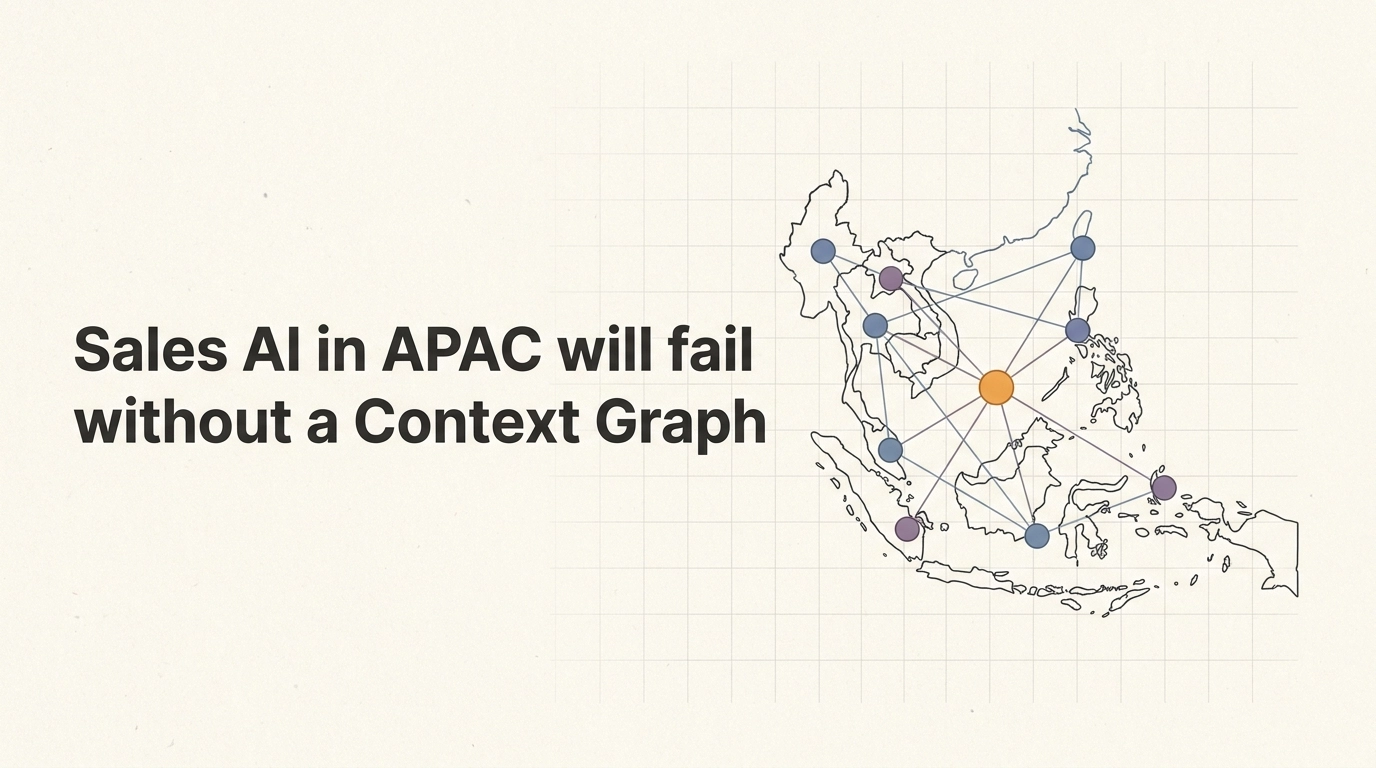
It is a living, structured representation of every entity that matters in a B2B sales motion. Not rows in a table. Nodes in a network, with typed relationships that carry meaning.
The architecture we built at SalesDuo has seven core entities: Organization, Person, Product, Deal, Signal, Interaction, Decision.
Most sales data models fail before they start. They conflate all of these. They create separate entities for Lead, Contact, MQL, SQL, Champion, Blocker, Decision Maker. Then spend the next three years merging duplicate records.
Our first principle is the opposite.
Keep entities to the minimum set of truly distinct things in the world. Push everything else into typed, attributed relationships between them.
A person’s role as champion, blocker, or budget-holder is not an intrinsic property. It is a relationship attribute relative to a specific deal.
The moment you model it that way, your data architecture gets dramatically simpler. And dramatically more powerful.
But the architecture is not the point.
The causal chain is.
The chain most AI systems break
Here is the most important insight in the entire context graph design:
Signals never directly cause decisions. Signals create context. Interactions happen within that context. Decisions emerge from Interactions.
The full chain: Signal → Context accumulates on Person/Org → Interaction happens → Decision is extracted → Deal advances or dies → Outcome recorded → Loop feeds back to signal weighting.
Almost every sales AI breaks this chain at step one.
They see a signal (a funding round, a hiring event, a job posting) and trigger an outbound sequence. They treat the signal as a decision trigger rather than a context signal.
The result: spray-and-pray with an AI label.
The right model is different.
A signal does not tell you to reach out. A signal enriches the context graph around a person and organisation. When enough signals of the right types accumulate, when the density and composition of the cluster crosses a threshold learned from your specific motion, your specific ICP, your specific product, then the system recommends an action.
The action is not a generic template. It is a contextually grounded engagement based on everything the graph knows about this account.
In APAC terms: the system knows it is Ramadan in Malaysia. It knows your champion just got promoted. It knows the company announced a regional expansion into Indonesia. It knows the last three times you reached out to this persona, the one that converted was a WhatsApp voice note, not an email.
It surfaces all of this at the moment of engagement. Not scattered across five tabs in five tools.
The three loops that make it self-learning
A context graph that does not learn is just a better filing cabinet.
The reason this architecture becomes a compound advantage is that every interaction feeds three distinct learning loops.
Loop one: signal precision improves with every reply.
Every signal SalesDuo fires has a downstream outcome. Replied. Ignored. Meeting booked. Champion changed. Deal closed.
A static tool fires the signal and forgets.
A self-learning agent watches what happened after every action it recommended and adjusts signal weighting accordingly.
Week one, signals are generic. Week ten, they are calibrated to your specific ICP in your specific market. The system learns that for your product, a new VP Sales hire at a Series B company in Singapore converts. A Series C hiring event in Australia does not.
No other system builds this map. Because no other system closes the loop between signal and outcome.
Loop two: the context graph gets denser with every interaction.
Week one, the graph is thin. It knows what you told it during onboarding.
Week four, it knows which accounts have three internal champions and which have none. It knows which deals have gone dark on email but are alive on WhatsApp.
Week twelve, the graph holds a version of institutional memory no human can maintain across fifty accounts simultaneously. And it survives when the rep leaves.
For APAC, this is the specific unlock. When relationship memory is the product, when the deal lives or dies on whether you remember the CFO’s assistant controls her calendar and you need to go through her, a system that stores, structures, and surfaces this context is not a productivity tool.
It is a competitive weapon.
Loop three: style and judgment converge on your voice.
Every draft the agent writes gets reviewed, edited, sent, or scrapped by a human. Every one of those decisions is feedback.
The agent learns you start with an observation, not a pitch. That you never use the word “synergy.” That founders in Southeast Asia respond to directness, not the corporate cadence that lands in London. That you sign off differently with a CFO than with a Head of Sales.
A generic AI writer produces something average for everyone. Average is the ceiling.
A self-learning agent produces something that sounds like your best rep. The gap between its draft and your final output narrows.
Then closes.
Why APAC is the right market to build this first
The Western AI sales market is crowded with tools optimising for the last ten percent of efficiency on a motion that already works.
APAC is a market where the fundamental motion is still being invented.
Enterprise software penetration is lower. CRM hygiene is worse. Sales teams are smaller, covering more ground, operating across more cultural and linguistic contexts. The signal landscape is different. The communication channels are different. The relationship structures are different.
These are not weaknesses.
They are structural advantages for a system designed to learn.
A self-learning context graph compounds faster in APAC because it starts from a lower baseline. There is more alpha to extract from proper signal intelligence for local markets, from structuring relationship context no CRM captures, from learning the specific communication patterns of buyers in each subregion.
The sales AI that wins APAC will not be a Western tool with a Southeast Asia flag on its pricing page.
It will be a system architected from first principles around the reality of multi-channel, multi-cultural, relationship-intensive selling. With a context graph at its core. And a closed feedback loop that makes every customer interaction smarter than the last.
What the closed loop looks like in practice
The feedback architecture is an eight-step cycle:
- Signals detected and accumulated on Person and Organisation nodes
- Rep acts — an Interaction is created, attributed to a specific seller, triggered by a specific signal
- Buyer responds — a second Interaction is recorded
- Decisions extracted from the Interaction by the reasoning layer — “Let’s do a PoC,” “I need to bring this to my CFO,” “We’re putting this on hold”
- Deal stage changes captured as signals back into the graph
- Outcome recorded — won, lost, churned
- Feedback collected — seller annotations on which signals were useful, which decisions were correctly extracted
- System learns — which Signal → Action → Decision → Outcome patterns produce wins, customised per workspace, per sales motion, per market
The critical architectural decision: decisions are always extracted from interactions. They cannot exist without a parent interaction.
This is not a detail. This is what lets the system learn from causality rather than correlation.
You are not just watching what signals preceded a win. You are watching what actions a seller took in response to specific signals. What decisions emerged from those conversations. What outcomes those decisions led to.
That is the chain most sales AI does not model.
That is what makes this a learning system rather than a pattern-matching one.
The honest part
We are early.
And everything above is about one slice of the sales motion: prospecting.
Finding the right accounts. Reading the right signals. Reaching out at the right moment with the right context. That is where the three loops are running today in production, on real workspaces.
Prospecting is the starting point. It is not the whole picture.
Negotiation is a different problem. Deal management is a different problem. Multi-threading a buying committee across six months and four stakeholders is a different problem. Each one has its own signals, its own interactions, its own decisions to extract.
The context graph is the foundation that lets all of it compound. But we have not built the full motion yet. We are starting where the leverage is highest and the pain is loudest, then moving down the funnel as the graph gets denser.
The reason to write this now is to declare the new age of sales in APAC. It is coming.
The next five years of B2B sales in APAC will be determined by who builds the best foundations first. The context graph is not a feature. It is the infrastructure everything else gets built on top of.
Signal intelligence. Deal management. Negotiation support. Rep coaching.
None of it compounds unless the system underneath it learns.
A static tool peaks on month one. A self-learning context graph gets sharper every time your team sells.
In a region where the relationship is the product, that compounding is the only advantage worth building.