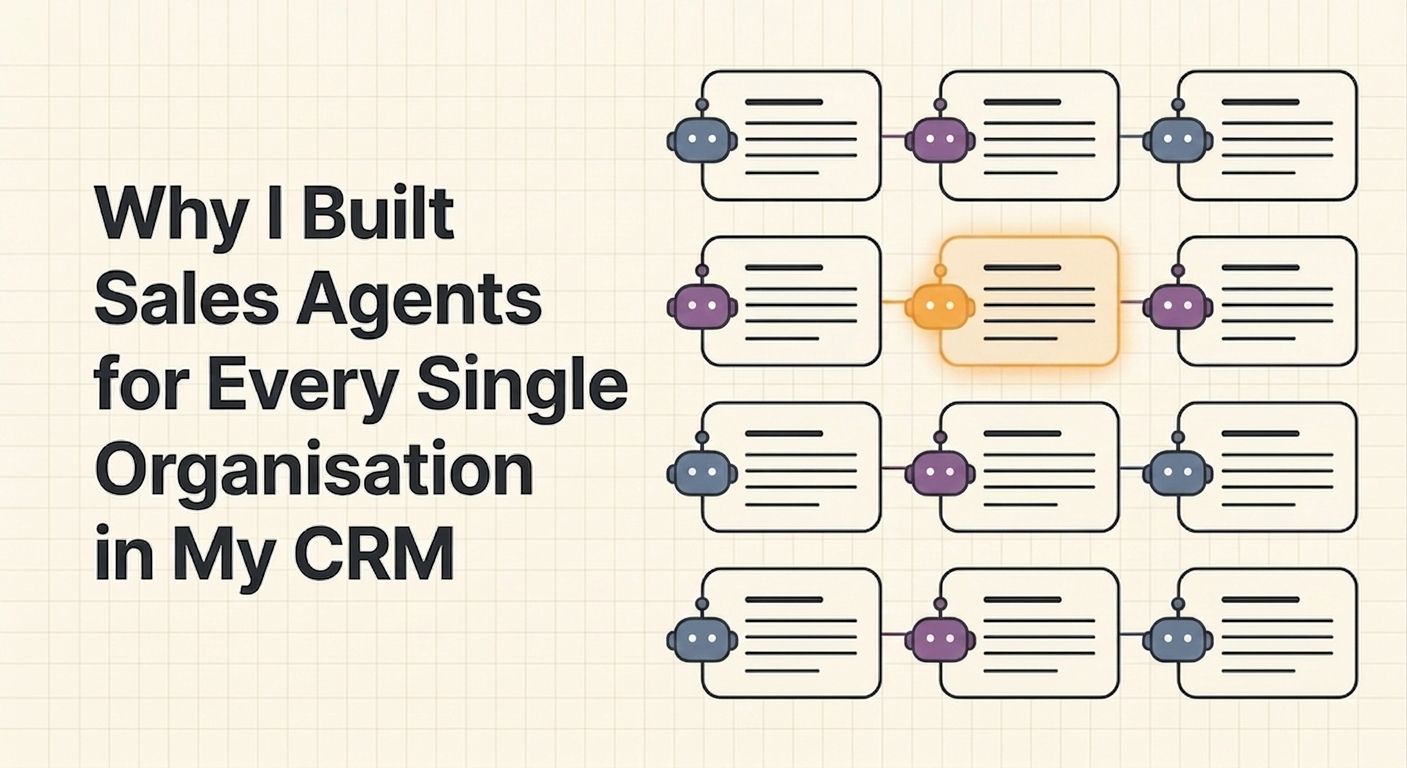

Every deal I have closed, I closed one account at a time. Not a stage at a time. Not a cohort. One organisation, one buying committee, relationships carried from the first signal to the signed contract and into the renewal. Any rep who has carried a quota will tell you the same.
Then look at how the industry is building AI sales agents. A qualification agent. A discovery agent. A negotiation agent. A closing agent. A renewal agent. The stack is sliced by pipeline stage, and the account gets passed between agents like a parcel down a conveyor belt.
I am writing this off years of selling in this region, sitting across the table from buyers. That experience is unambiguous: the deals worth winning are won by owning the account, not by working the stage. So I built SalesDuo's agents around the account, not the stage. Here is the reasoning.
The thought experiment that settled it
Imagine you sell into mid-market or enterprise and you have every resource in the world. Unlimited headcount. Unlimited budget. How do you staff a tier-one account?
You assign one AE to own it end to end. Fully personalised, fully accountable for the whole relationship, from the first signal to the renewal. That AE knows the CFO replies on WhatsApp and never opens email, knows the deal stalled because the buyer's parent company in Tokyo froze spend, knows the champion who left for a competitor and the one quietly replacing them.
Nobody with infinite resources assigns a "discovery rep", a "negotiation rep", and a "closing rep" to that account and hands the buyer off three times. You would never do it with humans. It fragments the relationship and forces the buyer to re-explain their world at every handoff.
So why build the AI version that way? If the ideal human structure is one owner per account, the ideal agent structure is one agent per account. The pipeline-stage model is not a design choice. It is a hangover from how we organised humans when humans were scarce. Agents are not scarce.
Pipeline-stage agents optimise for the wrong thing
Pipeline-stage agents share the same skills, the same tools, the same abilities. What they also share is memory. And that is where the model breaks.
- Account memory and domain context become a query bottleneck. The agent does not hold the account. It looks the account up. Every action starts with a fetch against a shared store, and the agent reasons over whatever fragment it pulled back. Context is a lookup, not a resident state.
- They optimise for repeatability, not adaptation. A stage agent is built to do the same thing the same way across every deal that reaches its stage. Repeatable action, repeatable outcome. That is efficient and it is also exactly why it cannot bend to the account in front of it.
- They deliver a one-to-many experience. One negotiation agent serves every deal in negotiation. The buyer is one of hundreds the agent touches that week. There is no version of that agent that belongs to this account.
This is the AI equivalent of a call centre. Cheap to scale, fine for transactional motions, wrong for the deals that actually pay the bills in APAC.
Account agents optimise for the account
Flip every property and you get the model I chose.
- Account memory and domain context are non-negotiable, and they are native to the agent. The agent does not query the account. It is the account. The buying committee, the channel preferences, the political map, the history of every interaction and decision live as the agent's resident context, not as a fragment it has to go and find.
- They optimise for adaptation, not repeatability. The job is to read this account's situation and respond to it, not to run the median play. The same input that two accounts share can demand opposite moves, and an account agent is structured to make them.
- They deliver a one-to-one experience. This agent belongs to this account. It carries the relationship across stages, channels, and time, the way a great AE does.
The structures are fundamentally different
This is the part most people miss. Account and stage agents are not two configurations of the same agent. The moment you choose one, your skills, memory, tools, planning, and thinking diverge.
| Dimension | Account agent | Pipeline-stage agent |
|---|---|---|
| Skills | Full-funnel, scoped to one account. The whole relationship is the unit of work, not a single transition in it. | Narrow and deep for one stage. Qualify. Negotiate. Close. Optimised for the action that moves a deal to the next stage. |
| Memory | Resident and account-scoped. The account's full history is the agent's working state, always present, never re-fetched from scratch. | Shared and queried on demand. Account context is fetched per action. The bottleneck is retrieval and reassembly. |
| Tools | Same tools, parameterised to this account: its channels (WhatsApp, LinkedIn, Slack, KakaoTalk, email), its language, its stakeholders, its cadence. | Generic toolset tuned to stage actions, applied the same way across every deal. |
| Planning | Orchestrate the whole account over time. Sequence touches across stages and channels toward the relationship, not the stage gate. | Move the deal to the next stage. Local optimisation, one transition at a time. |
| Thinking | Reason from this account's specifics. Adaptation is the goal. The median is a starting prior, not the answer. | Pattern-match to the median deal at this stage. Repeatability is the goal. |
You cannot bolt account-level adaptation onto a stage agent after the fact. A system built for repeatable, one-to-many actions has the wrong memory model, the wrong planning horizon, and the wrong default reasoning. The choice is architectural, and it is made on day one.
This is not a return to fragmented memory
There is an obvious objection, and I want to kill it before it lands. Did I not argue that fifty agents writing into fifty private memories is the thing destroying sales teams? Yes. Account agents are not that.
The distinction is between the system of record and the reasoning topology.
The context graph is the shared system of record. One schema, one ledger, every buyer, person, and decision resolved to a single node, written to and read from by every agent on the team. That stays shared. That is non-negotiable.
The account agent is the reasoning topology that sits on top of it. It does not own a private silo. It reads its account's slice of the shared graph as resident context, and it writes every new interaction and decision straight back into the same graph. So when two reps touch the same buyer, the record still collapses to one node. When a rep leaves, the context stays.
You get the one-to-one account experience without the ledger fragmentation. Shared memory of truth, account-scoped reasoning. Pipeline-stage agents give you neither: shared memory that is still a query bottleneck, and reasoning that belongs to no account at all.
Why this matters more in APAC than anywhere
In a market where the motion is transactional, one-language, one-channel, and low-stakeholder, pipeline-stage agents are defensible. That is not APAC.
An APAC enterprise deal runs eleven months, eleven stakeholders, four to seven countries, and five channels, two-thirds of it finished before a vendor is ever contacted. The relationship is the product. The context that decides the deal lives in a WhatsApp voice note, a deferral to regional HQ, a champion's promotion, a national holiday that went unspoken.
That is precisely the context a stage agent fetches as a fragment and an account agent holds as its resident state. Owning the account end to end is not a premium tier in APAC. It is the baseline expectation for any deal worth winning. The agent model has to match it.
The Monday test
One question to ask of any sales AI, your own build or a vendor's:
"When this agent acts on my account, is the account its memory, or its lookup?"
If the account is a lookup, you have a pipeline-stage agent wearing an account-shaped label. It will be repeatable, scalable, and quietly wrong on every deal that does not look like the median. If the account is its memory, you have an agent that can actually sell the way your best AE sells: one account at a time, adapting to what is in front of it, accountable for the whole relationship.
Reps have always sold account by account. The tools finally can too.
So before you build another agent, ask the three-year question, not the Monday one. The topology you choose now is not a feature you swap later. It fixes your memory model, your planning horizon, and how every future agent reasons. Pipeline stages optimise the motion that already works, on a foundation that cannot adapt. Account agents build toward how selling actually happens. Most teams are choosing the first without knowing they are choosing at all.
If you are setting an AI sales strategy meant to last, do not start with which agents to build. Start with the topology underneath them. Everything compounds from there, or it does not. That decision is not a tooling choice. It is the strategy.